
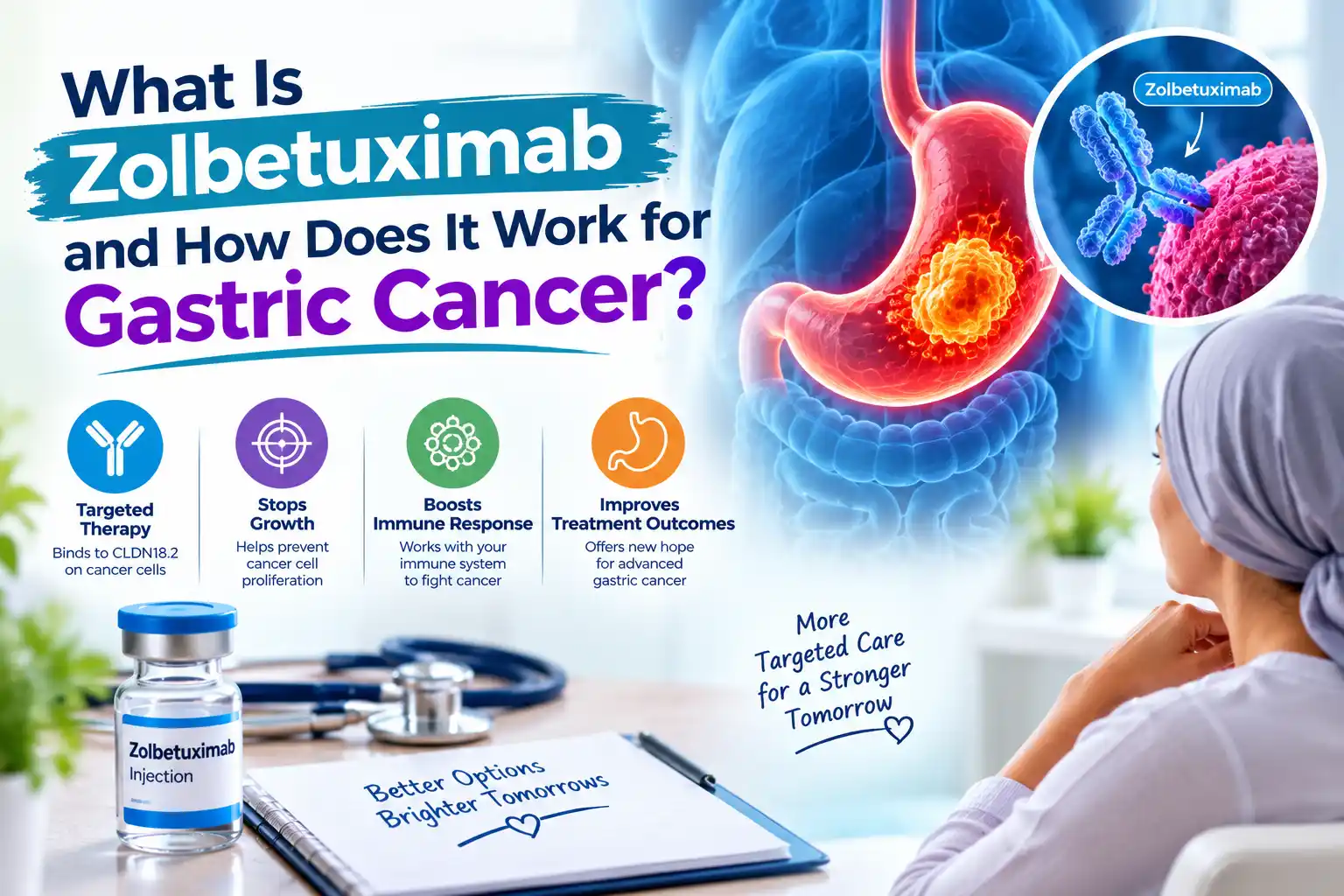
What Is Zolbetuximab and How Does It Work for Gastric Cancer?
 17 Oct 2026
For patients and families researching Zolbetuximab 100mg injection in Delhi, understanding how this newer targeted cancer treatment works can make discussions with an oncologist easier. Zolbetuximab is a monoclonal antibody designed to target a protein called claudin 18.2 (CLDN18.2), which can be present at high levels on certain gastric and gastroesophageal junction (GEJ) cancer cells. It is used in combination with specific chemotherapy for eligible patients whose tumors are CLDN18.2-positive and HER2-negative. The U.S. FDA approved zolbetuximab-clzb in October 2024 for this setting.
Unlike conventional chemotherapy, which can affect rapidly dividing cells more broadly, zolbetuximab is designed to recognize a particular molecular target. This makes biomarker testing an important part of determining whether a patient may be suitable for treatment.
What Is Zolbetuximab and What Is It Used For?
Zolbetuximab is a CLDN18.2-directed cytolytic monoclonal antibody. Its approved use in the United States is with fluoropyrimidine- and platinum-containing chemotherapy as first-line treatment for adults with locally advanced unresectable or metastatic HER2-negative gastric or GEJ adenocarcinoma when the tumor is confirmed to be CLDN18.2-positive using an approved diagnostic test.
The medicine is also known by its generic name zolbetuximab-clzb and the brand name Vyloy. It is supplied as a sterile powder for intravenous use, with FDA-listed presentations including 100 mg and 300 mg single-dose vials. Therefore, the phrase “100 mg injection” generally refers to the vial strength rather than a fixed dose that every patient receives.
This distinction is important because zolbetuximab dosing is based on body-surface area and the chemotherapy regimen being used. The medicine should therefore only be prepared and administered according to an oncologist's prescription.
How Does Zolbetuximab Work Against Gastric Cancer?
To understand zolbetuximab, it helps to understand CLDN18.2. Claudin 18.2 is a protein associated with tight junctions in epithelial tissues. In certain gastric cancers, this protein can become accessible on the surface of cancer cells, providing a potential target for antibody-based treatment.
Zolbetuximab is designed to bind to CLDN18.2 on cancer cells. Once attached, it can promote cancer-cell destruction through immune mechanisms known as antibody-dependent cellular cytotoxicity (ADCC) and complement-dependent cytotoxicity (CDC). The FDA prescribing information identifies both mechanisms as part of zolbetuximab's antitumor activity.
In simple terms, zolbetuximab acts like a targeting signal. It recognizes cells carrying the relevant CLDN18.2 marker and helps the immune system attack those cells.
However, the medicine is not intended to replace chemotherapy in its approved indication. It is administered alongside fluoropyrimidine- and platinum-containing chemotherapy, combining targeted antibody therapy with established anticancer treatment.
Why Is CLDN18.2 Testing Important?
Not every gastric cancer is CLDN18.2-positive. Therefore, testing the tumor for this biomarker is an important step before considering zolbetuximab.
The FDA-approved VENTANA CLDN18 (43-14A) RxDx Assay is a companion diagnostic intended to help identify patients with gastric or GEJ adenocarcinoma who may be eligible for VYLOY. The approved testing criteria identify tumors with at least 75% of viable tumor cells showing moderate-to-strong membranous CLDN18 staining.
This means that a diagnosis of gastric cancer alone does not automatically make someone a candidate for zolbetuximab. The oncologist needs to consider several factors, including tumor location, stage, HER2 status, CLDN18.2 expression, previous treatment, general health, and the appropriate chemotherapy combination.
Biomarker testing is therefore an important part of personalized oncology care.
Zolbetuximab 100mg Injection in Delhi: Who May Be Eligible?
Patients searching for Zolbetuximab 100mg injection in Delhi should first determine whether the treatment matches their diagnosis and biomarker profile. Under the FDA-approved indication, zolbetuximab is intended for adults with locally advanced unresectable or metastatic HER2-negative gastric or GEJ adenocarcinoma that is CLDN18.2-positive. It is used as first-line therapy in combination with fluoropyrimidine- and platinum-containing chemotherapy.
Eligibility is not determined by the medicine's availability alone. An oncologist may review pathology reports, immunohistochemistry results, imaging, blood tests, previous treatment history, organ function, and other clinical information before recommending therapy.
Patients should bring their pathology and biomarker reports to their oncology consultation. If CLDN18.2 testing has not been performed, the doctor can determine whether additional testing is appropriate.
How Is Zolbetuximab Administered?
Zolbetuximab is given as an intravenous infusion in a healthcare setting. It is not a medicine intended for self-injection at home.
The FDA-recommended dosage begins with an 800 mg/m² intravenous loading dose. Subsequent treatment may be given as 600 mg/m² every three weeks or 400 mg/m² every two weeks, depending on the chemotherapy regimen.
This explains why a 100 mg vial should not be interpreted as a 100 mg patient dose. Multiple vials may be needed to prepare the prescribed dose, and the exact quantity depends on the patient's body-surface area and treatment schedule.
Healthcare professionals also monitor patients during administration because zolbetuximab can cause infusion-related reactions and gastrointestinal adverse effects.
Common Side Effects Patients Should Know About
Zolbetuximab combined with chemotherapy can cause side effects. In the clinical trials supporting FDA approval, nausea and vomiting were among the most frequently reported adverse reactions. Other reported effects included reduced appetite, diarrhea, decreased blood-cell counts, and certain infusion-related reactions.
Patients should tell their healthcare team about persistent or severe symptoms rather than stopping treatment independently.
Supportive medicines may be recommended to help manage nausea, vomiting, or other treatment-related symptoms. The appropriate approach depends on the patient's health, chemotherapy regimen, and severity of symptoms.
What Were the Clinical Trial Results for Zolbetuximab?
The approval of zolbetuximab was supported by two randomized clinical trials known as SPOTLIGHT and GLOW. Together, these studies evaluated patients with previously untreated, advanced unresectable or metastatic, CLDN18.2-positive, HER2-negative gastric or GEJ adenocarcinoma.
In the SPOTLIGHT trial, patients received zolbetuximab with mFOLFOX6 chemotherapy or placebo with mFOLFOX6. Median progression-free survival was 10.6 months in the zolbetuximab group compared with 8.7 months in the placebo group. Median overall survival was 18.2 months versus 15.5 months, respectively.
In the GLOW trial, zolbetuximab was combined with CAPOX chemotherapy. Median progression-free survival was 8.2 months compared with 6.8 months for the placebo combination, while median overall survival was 14.4 months compared with 12.2 months.
These results describe outcomes in the specific clinical-trial populations and should not be interpreted as a prediction of an individual patient's response.
Zolbetuximab 100mg Injection in Delhi: What Should Patients Check?
When researching the Best Zolbetuximab 100mg injection in Delhi, patients should focus on the complete treatment pathway rather than selecting a medicine based only on vial price or availability.
Zolbetuximab is a prescription oncology medicine that requires appropriate storage, preparation, intravenous administration, and monitoring. The product presentation should also be checked carefully because approved presentations can include different vial strengths.
Before treatment, patients can discuss these practical points with their oncology team:
Whether CLDN18.2 testing has confirmed eligibility
Whether the tumor is HER2-negative
Which chemotherapy combination will be used
The prescribed zolbetuximab dose and infusion schedule
Expected side effects and supportive medicines
How infusion reactions or severe gastrointestinal symptoms will be managed
These discussions help patients understand why the medicine has been recommended and what to expect during treatment.
Can Patients Buy Zolbetuximab Without a Prescription?
Patients searching for Buy Zolbetuximab 100mg injection in Delhi should understand that zolbetuximab is a specialized prescription cancer medicine. It should be sourced through an authorized medical or pharmaceutical channel and used only under the direction of an oncology specialist.
Patients should verify the exact product name, active ingredient, vial strength, batch information, expiry date, packaging, and storage conditions with the authorized supplier and healthcare team.
UniMedNTech may be used as an informational resource when researching medicine availability, but the prescribing oncologist should remain the primary source for determining whether zolbetuximab is appropriate and what dose should be administered.
What Makes Zolbetuximab Different From Standard Chemotherapy?
Traditional chemotherapy generally works by interfering with processes involved in the growth and division of cancer cells. Zolbetuximab works differently by targeting a specific protein associated with CLDN18.2-positive cancer cells.
This targeted approach does not mean the medicine is free from side effects. Zolbetuximab is still used with chemotherapy and can contribute to treatment-related adverse effects. The goal is to use tumor biology to identify patients who may benefit from this particular treatment strategy.
The requirement for CLDN18.2 testing illustrates the growing role of precision medicine in gastric cancer. Instead of treating every tumor in exactly the same way, oncologists can use molecular and pathological information to guide treatment selection.
What Should Patients Discuss With Their Oncologist?
Before beginning treatment, patients should ask their oncologist why zolbetuximab is appropriate for their particular cancer and whether their pathology confirms CLDN18.2 positivity.
It is also useful to understand the chemotherapy combination being prescribed, the planned infusion schedule, possible adverse reactions, and the monitoring required during treatment.
Patients should disclose allergies, existing medical conditions, current medicines, supplements, and previous cancer treatments. They should also ask what symptoms require immediate medical attention.
Because treatment decisions are individualized, online information should be used to prepare questions rather than to determine a personal dose or treatment plan.
Conclusion
Zolbetuximab represents a targeted treatment approach for a specific group of patients with advanced gastric or gastroesophageal junction adenocarcinoma. By binding to CLDN18.2, it can help promote cancer-cell destruction through immune mechanisms such as ADCC and CDC. Its approved use is alongside fluoropyrimidine- and platinum-containing chemotherapy in eligible CLDN18.2-positive, HER2-negative disease.
For patients researching Zolbetuximab 100mg injection in Delhi, the key consideration is not simply finding a vial but confirming biomarker eligibility, the correct formulation, prescribed dose, and appropriate oncology supervision. A 100 mg vial represents a product presentation and does not mean that every patient receives 100 mg as their treatment dose.
Frequently Asked Questions
1. What is zolbetuximab used for?
It is used with chemotherapy for eligible adults with CLDN18.2-positive, HER2-negative advanced gastric or GEJ adenocarcinoma.
2. How does zolbetuximab work?
It binds to CLDN18.2 on cancer cells and promotes their destruction through immune mechanisms including ADCC and CDC.
3. Is CLDN18.2 testing required?
Testing is used to identify patients whose tumors have the biomarker required for the approved treatment indication.
4. Is zolbetuximab given as a regular injection?
No. It is administered as an intravenous infusion by healthcare professionals.
5. Does a 100 mg vial mean the patient receives 100 mg?
No. The 100 mg refers to the vial presentation. The prescribed dose is calculated according to the approved dosing regimen and the patient's body-surface area.