
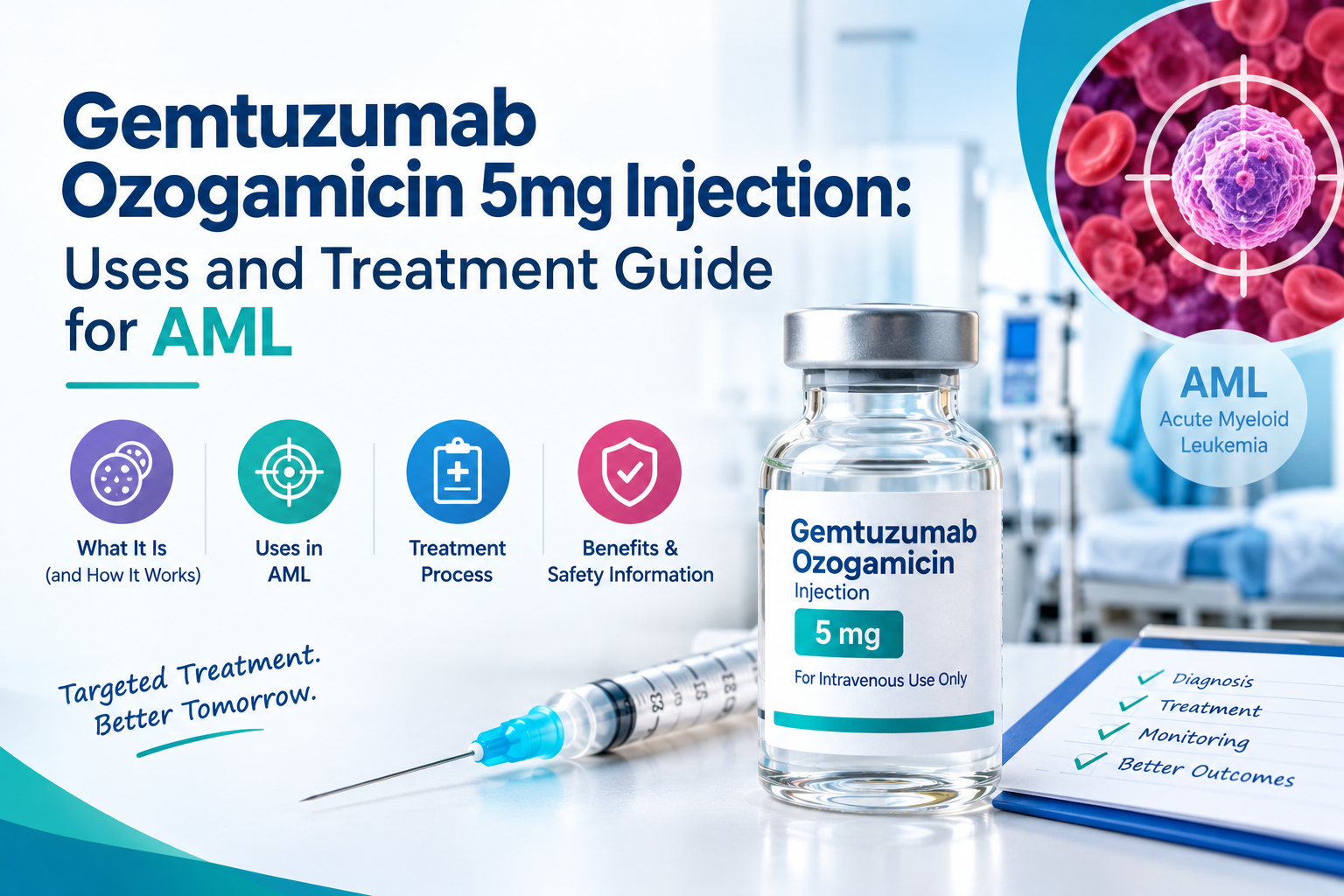
Gemtuzumab Ozogamicin 5mg Injection: Uses and Treatment Guide for AML
 18 Sep 2026
For people searching for Gemtuzumab Ozogamicin 5mg injection in Delhi, understanding how this medicine works, who may receive it, and what treatment involves can make an AML diagnosis easier to navigate. Gemtuzumab ozogamicin is a targeted cancer medicine used for certain patients with CD33-positive acute myeloid leukemia (AML). It belongs to a class called antibody-drug conjugates and is administered intravenously under specialist medical supervision.
AML is a rapidly progressing blood cancer that affects immature myeloid cells in the bone marrow. Treatment depends on factors such as the patient's age, general health, disease characteristics, genetic findings, previous treatment, and whether the leukemia is newly diagnosed or has returned. Gemtuzumab ozogamicin may be incorporated into treatment when the leukemia cells express the CD33 antigen.
What Is Gemtuzumab Ozogamicin 5mg Injection in Delhi?
Gemtuzumab ozogamicin is a CD33-directed antibody-drug conjugate (ADC). It combines a monoclonal antibody that targets CD33 with a cytotoxic component called calicheamicin. After binding to CD33 on leukemia cells, the medicine is taken into the cell, where the cytotoxic component is released and contributes to cell death.
The medicine is given as an intravenous infusion rather than being taken orally. Because it can cause serious reactions, administration requires trained healthcare professionals and appropriate monitoring.
The term “5 mg injection” refers to the vial strength used in certain product formulations. Importantly, this does not mean every patient receives a fixed 5 mg dose. Depending on the indication and regimen, dosing can be based on body surface area, with maximum dose limits specified by the prescribing information.
For anyone researching the Best Gemtuzumab Ozogamicin 5mg injection in Delhi, the focus should be on obtaining an authentic, appropriately stored medicine and using it according to an oncologist's prescription rather than choosing a product based only on price or availability.
What Is Gemtuzumab Ozogamicin 5mg Injection in Delhi Used For?
Gemtuzumab ozogamicin is used for certain patients with CD33-positive AML. U.S. regulatory information includes its use in newly diagnosed CD33-positive AML and in relapsed or refractory CD33-positive AML, with specific age and treatment-regimen considerations.
CD33 is a protein found on the surface of many myeloid leukemia cells. Testing the leukemia cells for CD33 can therefore help doctors determine whether a CD33-targeted treatment may be appropriate.
The medicine may be used as part of combination chemotherapy or as a single-agent treatment depending on the patient's clinical situation. Treatment decisions can differ substantially between newly diagnosed AML and relapsed or refractory disease.
It is also important to distinguish AML from acute promyelocytic leukemia (APL), a specific subtype of acute myeloid leukemia that has different treatment approaches. Gemtuzumab ozogamicin is not automatically appropriate for every form of AML.
How Does Gemtuzumab Ozogamicin Work Against AML?
Gemtuzumab ozogamicin works through a targeted mechanism. Its antibody component recognizes the CD33 antigen on the surface of susceptible leukemia cells. Once the drug binds to CD33, the complex can be internalized by the cell.
Inside the cell, the calicheamicin-derived cytotoxic component is released. This component damages DNA, ultimately interfering with the leukemia cell's ability to survive. This combination of targeted recognition and cytotoxic activity is what makes gemtuzumab ozogamicin an antibody-drug conjugate.
This mechanism does not mean the medicine affects only leukemia cells. CD33 can also be found on some normal myeloid cells, which helps explain why treatment can affect normal blood-cell production and why careful blood-count monitoring is necessary.
How Is Gemtuzumab Ozogamicin Administered?
Gemtuzumab ozogamicin is administered through an IV infusion after reconstitution and dilution. The exact dose and schedule depend on the patient's AML setting and the treatment regimen selected by the hematologist or oncologist.
For example, one approved combination regimen for newly diagnosed, de novo CD33-positive AML uses 3 mg/m² per dose, up to a maximum of one 5 mg vial, on Days 1, 4, and 7, together with daunorubicin and cytarabine. Patients who require a second induction course do not receive gemtuzumab ozogamicin during that second induction under this regimen.
Other approved treatment schedules are used in different AML settings. Therefore, patients should never use the schedule from another patient or online source as a personal dosing plan.
Before treatment, healthcare professionals may provide medicines such as corticosteroids, antihistamines, and acetaminophen to reduce the risk of infusion-related reactions.
What Are the Benefits of Targeted Treatment for CD33-Positive AML?
The main advantage of gemtuzumab ozogamicin is its ability to specifically recognize the CD33 antigen and deliver a cytotoxic payload to CD33-expressing cells.
When used in an appropriate AML treatment setting, it may help improve disease control and contribute to achieving remission. Clinical research supporting its approval has evaluated gemtuzumab ozogamicin in both newly diagnosed and relapsed or refractory CD33-positive AML.
However, response varies between patients. AML is biologically diverse, and treatment selection depends on factors beyond CD33 expression. Cytogenetic and molecular findings, measurable residual disease, previous therapy, transplant eligibility, and overall health may all influence treatment decisions.
Important Safety Considerations
Gemtuzumab ozogamicin requires careful monitoring because it can cause potentially serious adverse reactions. One of the most important concerns is hepatotoxicity, including hepatic veno-occlusive disease (VOD), also called sinusoidal obstruction syndrome. Liver function and clinical signs of liver injury require careful monitoring.
Other important risks include infusion-related reactions, bleeding, infections, and low blood-cell counts. Patients may also experience symptoms such as nausea, vomiting, fever, headache, constipation, rash, or mucositis.
Patients should promptly inform their medical team about new or worsening symptoms rather than attempting to manage significant reactions independently.
Key monitoring considerations include:
Blood counts and signs of infection
Liver enzymes and bilirubin
Symptoms suggesting bleeding
Infusion-related or hypersensitivity reactions
Fluid retention, rapid weight gain, abdominal swelling, or other possible signs of liver complications
The treatment team may delay, modify, or discontinue therapy depending on laboratory results and the severity of adverse reactions.
What Should Patients Know Before Buying the Medicine?
If you are researching how to Buy Gemtuzumab Ozogamicin 5mg injection in Delhi, remember that this is a specialized prescription oncology medicine. It should be sourced through an appropriate medical or pharmaceutical channel and administered only under qualified medical supervision.
Patients should confirm the exact medicine name, strength, formulation, batch information, expiry date, storage requirements, and prescription details before treatment. Proper storage is particularly important because product information specifies refrigerated storage and protection from light for certain formulations.
An online listing alone should not be considered proof that a medicine is authentic or suitable for a particular patient. UniMedNTech can be considered when discussing medicine sourcing, but the treating oncologist should determine whether gemtuzumab ozogamicin is appropriate and which regimen should be followed.
What Happens During AML Treatment?
AML treatment often involves several stages rather than a single infusion. Depending on the patient's diagnosis and treatment plan, therapy may include induction, consolidation, continuation treatment, targeted medicines, supportive care, or hematopoietic stem-cell transplantation.
Gemtuzumab ozogamicin can form part of a broader AML treatment strategy. In combination regimens, it may be administered alongside medicines such as daunorubicin and cytarabine. The exact schedule depends on the approved regimen and individual clinical circumstances.
Patients should understand that receiving this medicine does not eliminate the need for regular blood tests, physical assessments, infection monitoring, and other AML-related care.
How to Choose the Right Treatment Support in Delhi
When considering the Best Gemtuzumab Ozogamicin 5mg injection in Delhi, patients and caregivers should prioritize clinical reliability over promotional claims. A specialized hematology or oncology team can help coordinate diagnosis, treatment selection, medicine administration, laboratory monitoring, and management of adverse effects.
It is equally important to maintain communication with the treating team throughout therapy. AML can change quickly, and treatment decisions may need to be adjusted according to blood counts, disease response, organ function, and other clinical findings.
Patients should also avoid self-medicating with supplements, herbal products, or over-the-counter medicines without first discussing them with their healthcare team.
Conclusion
Gemtuzumab ozogamicin is an important targeted therapy for selected patients with CD33-positive AML. Gemtuzumab Ozogamicin 5mg injection in Delhi may be considered as part of an appropriate AML treatment plan, but its use depends on the patient's leukemia subtype, CD33 status, treatment history, overall health, and the regimen selected by the oncology team.
Because gemtuzumab ozogamicin can cause serious complications, including liver toxicity, infusion reactions, bleeding, and infections, it should only be administered under specialist supervision with appropriate monitoring.
Patients seeking treatment should verify the medicine's formulation and source and follow the exact dosing and monitoring plan prescribed by their hematologist or oncologist.
Frequently Asked Questions
1. What is gemtuzumab ozogamicin used for?
It is used for certain patients with CD33-positive acute myeloid leukemia.
2. Is gemtuzumab ozogamicin chemotherapy?
It is an antibody-drug conjugate that combines a CD33-targeting antibody with a cytotoxic drug.
3. Is the dose always 5 mg?
No. The 5 mg designation can refer to the vial strength. The prescribed dose depends on the specific AML regimen and may be calculated using body surface area.
4. How is gemtuzumab ozogamicin given?
It is administered intravenously after reconstitution and dilution, under medical supervision.
5. What are the major risks?
Important risks include hepatotoxicity, including VOD, infusion-related reactions, bleeding, infections, and blood-cell abnormalities.