
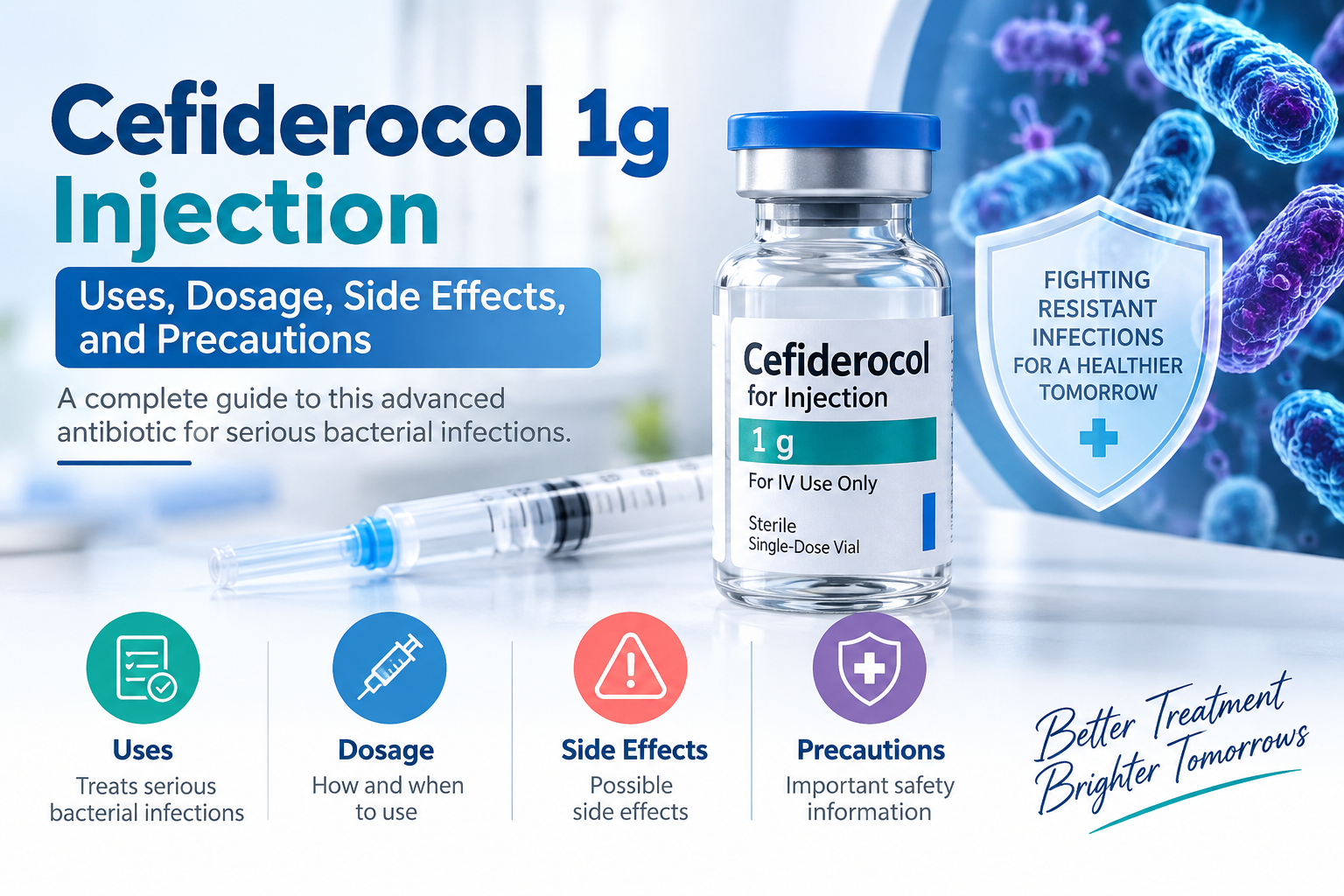
Cefiderocol 1g Injection: Uses, Dosage, Side Effects, and Precautions
 17 Sep 2026
Cefiderocol is a newer cephalosporin antibiotic used for certain serious infections caused by susceptible Gram-negative bacteria. Patients and caregivers searching for Cefiderocol 1g injection in Delhi should understand that this medicine is administered by intravenous infusion under medical supervision and is not intended for self-use. It may be considered when bacterial infections are difficult to treat or when limited antibiotic options are available. The exact treatment plan depends on the infection, bacterial susceptibility, kidney function, and the patient's overall health.
What Is Cefiderocol 1g Injection?
Cefiderocol is a siderophore cephalosporin antibacterial medicine. It has a distinctive mechanism that helps the drug enter Gram-negative bacterial cells by taking advantage of their iron-transport system. Once inside the bacterial cell, it interferes with bacterial cell-wall synthesis, ultimately helping to stop bacterial growth.
The medicine is supplied as a sterile, lyophilized powder in a single-dose vial containing 1 gram of cefiderocol. Importantly, Cefiderocol 1g injection in Delhi refers to the strength of the vial and does not necessarily mean that every patient receives exactly 1 gram as the complete treatment dose. Depending on kidney function and the prescribed regimen, a patient may require more or less than one vial per administration.
Because cefiderocol is a prescription antibacterial, it should be selected by a qualified healthcare professional after considering the suspected or confirmed bacterial infection and available susceptibility information.
Cefiderocol 1g Injection in Delhi: What Is It Used For?
Cefiderocol is used for specific serious bacterial infections caused by susceptible Gram-negative microorganisms. Current prescribing information includes complicated urinary tract infections, including pyelonephritis, and hospital-acquired or ventilator-associated bacterial pneumonia in appropriate adult patients.
The antibiotic may be particularly relevant when bacteria show resistance to several commonly used antibacterial medicines. However, cefiderocol should not be considered a general-purpose antibiotic for every infection. Antibiotic selection should be based on clinical assessment, laboratory testing, culture results when available, and antimicrobial susceptibility.
Common clinical situations may include:
Complicated urinary tract infections and kidney infections caused by susceptible Gram-negative bacteria.
Hospital-acquired bacterial pneumonia or ventilator-associated bacterial pneumonia caused by susceptible organisms.
The medicine is not effective against viral illnesses such as influenza or the common cold. Using an antibacterial drug unnecessarily can contribute to antimicrobial resistance and may expose the patient to avoidable adverse effects.
How Does Cefiderocol Work?
Many Gram-negative bacteria require iron for growth and have specialized systems for obtaining it. Cefiderocol uses a siderophore-like strategy to take advantage of these iron-transport pathways. After entering the bacterial cell, the cefiderocol component binds to penicillin-binding proteins and interferes with cell-wall production.
This mechanism is one reason cefiderocol has attracted interest in the management of certain difficult-to-treat Gram-negative infections. Nevertheless, its use should remain targeted because resistance can develop and the clinical response depends on the susceptibility of the infecting organism.
Cefiderocol 1g Injection in Delhi: Dosage and Administration
The dose of cefiderocol is determined by a healthcare professional. It is given through an intravenous infusion rather than as a routine intramuscular injection or oral tablet. The current prescribing information recommends a standard adult dose of 2 grams every 8 hours for patients with creatinine clearance of 60–119 mL/min. Dose adjustments are required when kidney function is significantly reduced or when creatinine clearance is 120 mL/min or greater.
For example, current dosing information lists different regimens according to estimated creatinine clearance. Patients with creatinine clearance of 30–59 mL/min may receive 1.5 grams every 8 hours, while those with 15–29 mL/min may receive 1 gram every 8 hours. Patients with creatinine clearance below 15 mL/min may receive 0.75 gram every 12 hours, with additional considerations for patients receiving dialysis.
This means a 1-gram vial is a dosage form/strength, not an instruction for patients to determine their own dose.
Cefiderocol is administered by IV infusion, and current product information specifies a three-hour infusion. Treatment commonly lasts 7–14 days, although the duration is determined by the treating physician according to the infection and clinical response.
Healthcare professionals also need to monitor renal function because cefiderocol is primarily eliminated through the kidneys. The dosage may need to be changed if kidney function changes during treatment.
Who May Need Cefiderocol?
Cefiderocol may be considered when a clinician determines that a susceptible Gram-negative bacterial infection requires this antibiotic. This can involve organisms such as Escherichia coli, Klebsiella pneumoniae, Pseudomonas aeruginosa, Enterobacter cloacae complex, and other susceptible bacteria, depending on the approved indication and local clinical guidance.
The decision should not be based only on symptoms. Doctors may use blood tests, urine cultures, respiratory samples, imaging, and antimicrobial susceptibility testing to determine the most appropriate treatment.
For patients looking for the Best Cefiderocol 1g injection in Delhi, the focus should be on obtaining an appropriately prescribed and properly stored medicine from a legitimate, licensed source rather than choosing a product solely because of price or availability. A healthcare professional or hospital pharmacy can help verify the appropriate product and treatment requirements.
Common Side Effects of Cefiderocol
Like other antibiotics, cefiderocol can cause side effects. The reported adverse reactions include gastrointestinal symptoms, infusion-site reactions, skin reactions, and changes in laboratory test results. In clinical data, diarrhea, infusion-site reactions, constipation, rash, candidiasis, cough, increased liver tests, headache, low potassium, nausea, and vomiting were among reported reactions.
Not every patient experiences these effects, and their severity can vary. Patients should inform their healthcare provider if symptoms become persistent, severe, or unusual during treatment.
An antibiotic can also disturb normal bacterial flora and may allow fungal infections such as candidiasis to develop. Severe or persistent diarrhea should not automatically be assumed to be a minor side effect because antibiotic-associated intestinal infections can require medical assessment.
Important Precautions Before Treatment
Before receiving cefiderocol, tell the healthcare professional about previous allergies to cefiderocol, cephalosporins, penicillins, or other beta-lactam antibiotics. The medicine is contraindicated in patients with a known history of severe hypersensitivity to cefiderocol, other beta-lactam antibacterial drugs, or its components.
Kidney function is another major consideration. Because the medicine is substantially eliminated through the kidneys, dosage adjustments may be necessary in patients with renal impairment, those receiving hemodialysis, or patients undergoing continuous renal replacement therapy. Renal function may also change during serious illness, so monitoring can be necessary throughout treatment.
Patients should also tell their doctor about other medicines and medical conditions. During treatment, clinicians may monitor laboratory parameters and assess the patient's clinical response.
When arranging to Buy Cefiderocol 1g injection in Delhi, patients should not purchase or administer it without a valid prescription and professional guidance. Hospital pharmacies and authorized pharmaceutical suppliers are preferable because injectable antibiotics require appropriate handling, storage, preparation, and administration.
Where to Obtain Cefiderocol Safely in Delhi
Availability of specialized injectable antibiotics can vary between hospitals, pharmacies, and pharmaceutical suppliers. Patients should first obtain a prescription and confirm the required strength and quantity with their doctor or hospital pharmacy.
A reliable supplier should be able to provide appropriate product information, batch details, expiry information, and proper storage conditions. UniMedNTech may be considered as a pharmaceutical sourcing option, but patients should still verify availability, prescription requirements, product authenticity, and suitability with a qualified healthcare professional before purchase.
Conclusion
Cefiderocol is an important option for selected serious infections caused by susceptible Gram-negative bacteria, particularly when treatment choices may be limited. The 1-gram vial is a pharmaceutical strength, while the actual dose is individualized according to factors such as kidney function and infection type. Anyone searching for Cefiderocol 1g injection in Delhi should prioritize a valid prescription, an authentic product, proper storage, and administration by qualified healthcare professionals.
Because this medicine is a potent intravenous antibiotic, patients should not determine the dose or treatment duration themselves. A doctor should assess the infection, review relevant laboratory findings, evaluate kidney function, and monitor the patient's response throughout therapy.
Frequently Asked Questions
1. Is cefiderocol a 1 gram injection?
Cefiderocol is supplied in 1-gram single-dose vials. The prescribed treatment dose may be higher or lower depending mainly on kidney function and the clinical situation.
2. Is cefiderocol given by IV?
Yes. Cefiderocol is administered through intravenous infusion by trained healthcare professionals.
3. Can cefiderocol be used for every bacterial infection?
No. It is intended for specific susceptible bacterial infections and should be prescribed based on clinical assessment and, when appropriate, susceptibility testing.
4. Does kidney function affect the cefiderocol dose?
Yes. Dosage adjustments are required for several levels of reduced or unusually high creatinine clearance, and renal function should be monitored during treatment.
5. Can I buy cefiderocol without a prescription?
Cefiderocol is a prescription injectable antibiotic. It should be obtained and administered under appropriate medical supervision rather than self-purchased for unsupervised use.